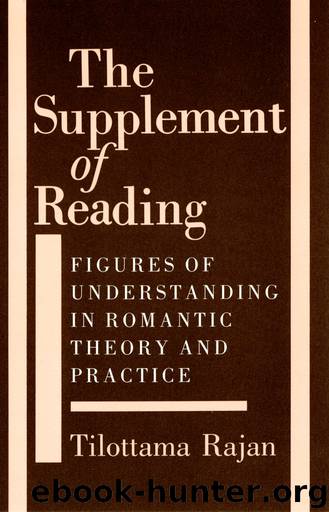
The Supplement of Reading by Tilottama Rajan
Author:Tilottama Rajan
Language: eng
Format: epub
Publisher: Cornell University Press
Published: 2017-12-29T16:00:00+00:00
Caleb Williams: Metafiction and the Hermeneutics of Suspicion
It is partly because Wollstonecraft herself did not superintend the publication of the manuscript that we can, to borrow Macherey’s important distinction, read The Wrongs of Woman as “produced under determinate conditions” rather than “created by an intention,”23 and hence as available for historical reading. The circumstances of the novel’s publication of course simply foreground a feature of all texts: namely, that they are the property of their readers as well as their authors. Nevertheless, there are writings in which the status of the text as production is something that emerges in the process of its transmission, and ones that deliberately question a substantialist ontology of the text. The Wrongs of Woman falls into the first category. Godwin’s Caleb Williams, by contrast, is a work of political metafiction that explicitly raises the question of the relationship between writing, reading, and political action.
To begin with, Williams is employed as Falkland’s secretary and librarian, with the task of reading books on Falkland’s behalf and preparing “an analytical survey of the plans of different authors, and conjectural speculations upon hints they afforded, tending either to the detection of their errors or the carrying forward their discoveries” (CW, p. 6). Moreover, in the later part of the novel he is himself the subject of tales and misrepresentation, and his memoir (Godwin’s novel) is therefore addressed to a future reader who must similarly detect error and forward discovery. It is not until Godwin revised the ending, however, that the novel became truly metafictional, making the final courtroom confrontation into a scene of reading rather than a battle of wills, and retrospectively making reading the object of the novel’s scrutiny as well as the mode of its operation. The original novel relies on an almost crude hermeneutics of reversal to convert things as they are into things as they should be. It raises reading to a certain level of thematic prominence in the book because the reader is the means by which the vindication of Caleb is to be effected. But Godwin, as is well known, conceived his novel backward, beginning with the third section and the original ending, and ending with the first section. The middle and opening sections are concerned with the “analysis of the private and internal operations of the mind” and employ a “metaphysical dissecting knife in tracing and laying bare the involutions of motive” (CW, p. 339). As Godwin wrote, the opposition between Caleb and Falkland began to collapse, and an ending based on that opposition must have come to seem a repression of the novel’s moral complexities. For if Falkland and Caleb are not simply antagonists but also doubles, the fact that the novel is a first-person narrative by Caleb can no longer hinder us from applying to his text whatever methods of reading he applies to Falkland’s representation of himself. The revised ending takes account of the disturbing kinship be ween the Promethean Caleb and his Jovian opponent and makes this kinship
Download
This site does not store any files on its server. We only index and link to content provided by other sites. Please contact the content providers to delete copyright contents if any and email us, we'll remove relevant links or contents immediately.
4 3 2 1: A Novel by Paul Auster(12352)
The handmaid's tale by Margaret Atwood(7725)
Giovanni's Room by James Baldwin(7293)
Asking the Right Questions: A Guide to Critical Thinking by M. Neil Browne & Stuart M. Keeley(5734)
Big Magic: Creative Living Beyond Fear by Elizabeth Gilbert(5721)
Ego Is the Enemy by Ryan Holiday(5383)
The Body: A Guide for Occupants by Bill Bryson(5062)
On Writing A Memoir of the Craft by Stephen King(4909)
Ken Follett - World without end by Ken Follett(4701)
Adulting by Kelly Williams Brown(4549)
Bluets by Maggie Nelson(4533)
Eat That Frog! by Brian Tracy(4497)
Guilty Pleasures by Laurell K Hamilton(4416)
The Poetry of Pablo Neruda by Pablo Neruda(4077)
Alive: The Story of the Andes Survivors by Piers Paul Read(4009)
White Noise - A Novel by Don DeLillo(3987)
Fingerprints of the Gods by Graham Hancock(3974)
The Book of Joy by Dalai Lama(3957)
The Bookshop by Penelope Fitzgerald(3826)
